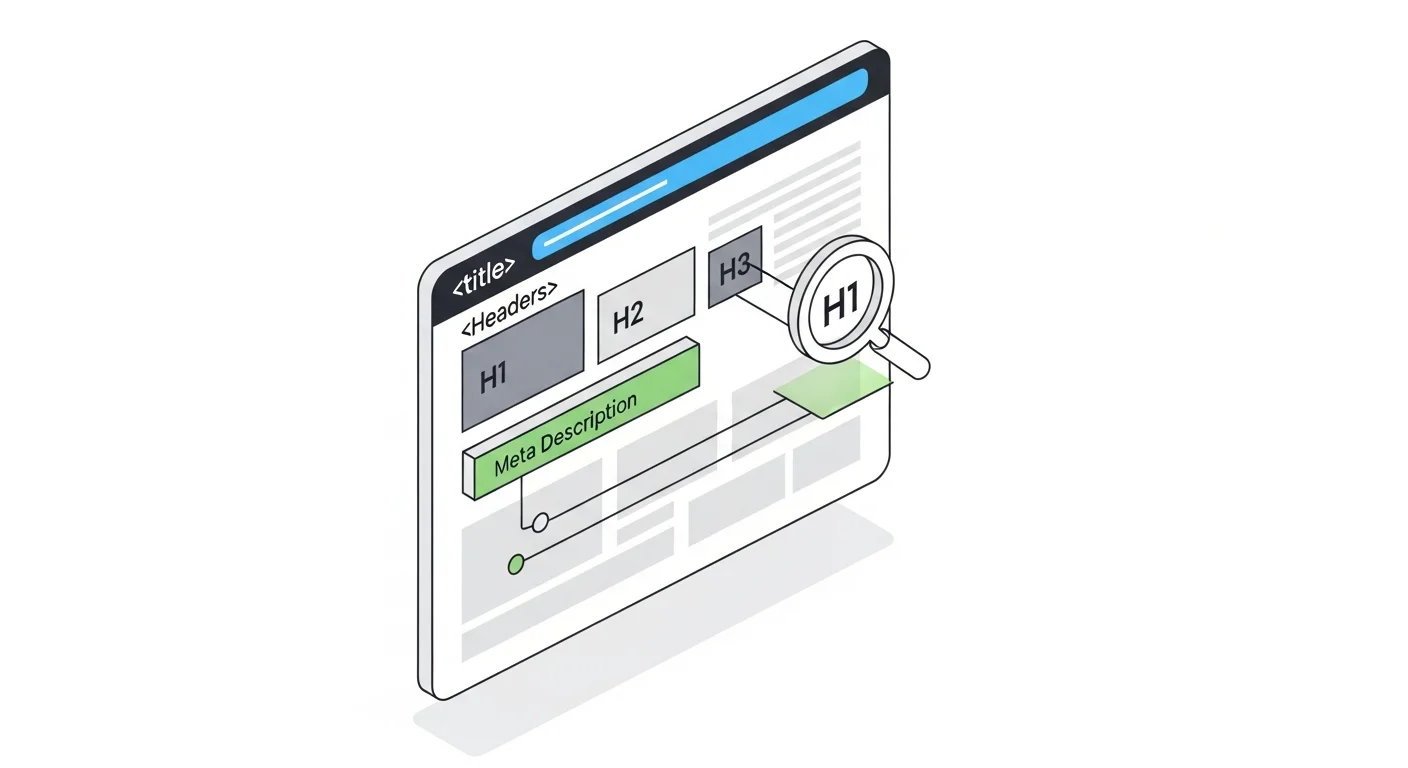
On-Page SEO Optimization: Complete Checklist for 2025
You can have the best content in the world, but if search engines can't understand it — nobody will find it.
On-page SEO is your foundation. It's the difference between ranking on page one and getting buried on page five. And the good news? It's completely within your control.
This guide gives you a practical, actionable checklist you can apply to any page today. No fluff, no theory — just proven techniques that work in 2025.
Related: For a complete SEO strategy including technical optimization and link building, check out our Search Engine Optimization Promotion Guide.
What Is On-Page SEO?
On-page SEO is everything you do on your website to help search engines understand and rank your content:
- Title tags and meta descriptions
- Header structure (H1, H2, H3)
- URL optimization
- Content quality and keyword usage
- Image optimization
- Internal linking
- Schema markup
Unlike off-page SEO (backlinks, brand mentions), on-page factors are 100% in your control. Master them first.
1. Title Tag Optimization
Your title tag is the single most important on-page factor. It appears in search results and browser tabs.
Best Practices
| Element | Recommendation |
|---|
| Length | 50-60 characters (Google truncates longer titles) |
| Keyword placement | Front-load your primary keyword |
| Brand | Add brand name at the end (if space allows) |
| Uniqueness | Every page needs a unique title |
Examples
Before (weak):
Home - Our Company Website
After (optimized):
Web Development Services | Custom Sites in 2-4 Weeks — WebProd
[Primary Keyword] + [Benefit/Modifier] + [Brand]
Examples:
SEO Audit Checklist: 50+ Points to Check — WebProdTelegram Bot Development for Business | Fast & Reliable
Common Mistakes to Avoid
- Keyword stuffing ("SEO SEO Services SEO Agency SEO")
- Generic titles ("Welcome to Our Website")
- Missing titles (some CMS leave this blank)
- Duplicate titles across pages
Meta descriptions don't directly affect rankings, but they dramatically impact click-through rates.
Optimization Rules
| Element | Recommendation |
|---|
| Length | 150-160 characters |
| Call-to-action | Include "Learn how", "Discover", "Get started" |
| Keywords | Include primary keyword (Google bolds it) |
| Uniqueness | Never duplicate descriptions |
[What it is] + [Key benefit] + [CTA or differentiator]
Example:
Complete on-page SEO checklist for 2025. Optimize title tags,
meta descriptions, headers, and images. Free downloadable checklist included.
Pro Tips
- Write descriptions that answer search intent
- Use numbers when possible ("10 tips", "in 5 minutes")
- Create urgency without being spammy ("Updated for 2025")
- Test different versions — track CTR in Google Search Console
Headers create hierarchy. They help users scan content and tell Google what's important.
The Golden Rules
| Rule | Explanation |
|---|
| One H1 per page | This is your main headline (matches page topic) |
| Logical hierarchy | H2 → H3 → H4 (don't skip levels) |
| Keywords in headers | But naturally — no stuffing |
| Descriptive headers | Users should understand content from headers alone |
Proper Structure Example
# Complete Guide to Email Marketing (H1)
  ## Why Email Marketing Matters in 2025 (H2)
  ## Building Your Email List (H2)
    ### Lead Magnets That Convert (H3)
    ### Opt-in Form Placement (H3)
  ## Writing Emails That Get Opened (H2)
    ### Subject Line Formulas (H3)
    ### Email Body Best Practices (H3)
Common Mistakes
- Using H1 for the logo (it should be your page title)
- Skipping from H1 to H3 (breaks hierarchy)
- Using headers for styling only (use CSS instead)
- Headers that don't describe the section content
4. URL Structure
Clean URLs help users and search engines understand your page content.
URL Best Practices
| Do | Don't |
|---|
/blog/seo-checklist/ | /blog/post?id=12345 |
/services/web-development/ | /services.php?cat=1&sub=4 |
| Short and descriptive | Long with unnecessary words |
| Lowercase only | Mixed case (causes duplicates) |
URL Optimization Checklist
Examples
Before:
https://example.com/2024/03/15/the-complete-ultimate-guide-to-seo/
After:
https://example.com/blog/seo-guide/
5. Content Optimization
Great content is the foundation. Here's how to optimize it for both users and search engines.
Keyword Usage
| Location | Recommendation |
|---|
| First 100 words | Include primary keyword |
| Throughout content | Natural usage (1-2% density max) |
| Headers | In H2s and some H3s |
| Image alt text | Where relevant |
Content Quality Signals
Google measures quality through:
- Comprehensiveness — Cover the topic fully
- Originality — Say something new
- Expertise — Show you know the subject (E-E-A-T)
- Freshness — Update regularly
- Readability — Short paragraphs, clear language
Content Formatting Checklist
Semantic Keywords
Don't just repeat your main keyword. Use related terms:
Primary keyword: "email marketing"
Semantic keywords: newsletter, subscribers, open rate, automation, drip campaign, email list, conversion rate
Tools to find semantic keywords:
- Google's "People Also Ask"
- Google's related searches
- AnswerThePublic
- Semrush's Topic Research
6. Image Optimization
Images affect page speed, accessibility, and SEO. Optimize every single one.
Image SEO Checklist
| Element | Best Practice |
|---|
| File name | seo-checklist-infographic.webp (not IMG_1234.jpg) |
| Alt text | Descriptive, includes keyword where natural |
| Format | WebP for best compression |
| Size | Under 100KB for most images |
| Dimensions | Exactly what you need (don't rely on CSS scaling) |
| Lazy loading | Enable for below-the-fold images |
Alt Text Examples
Bad:
<img alt="image" src="...">
<img alt="" src="...">
<img alt="SEO SEO checklist SEO guide" src="...">
Good:
<img alt="On-page SEO checklist infographic showing 10 optimization steps" src="...">
- Squoosh (free, browser-based)
- TinyPNG (free tier available)
- ImageOptim (Mac app)
- ShortPixel (WordPress plugin)
7. Internal Linking Strategy
Internal links distribute authority, help users navigate, and create topic clusters.
Internal Linking Rules
| Principle | Application |
|---|
| Every page needs incoming links | No orphan pages |
| Link from high-authority pages | Homepage, popular posts |
| Use descriptive anchor text | Not "click here" |
| Link to related content | Creates topic clusters |
| Don't overdo it | 3-5 internal links per 1000 words |
Topic Cluster Model
              [Pillar Page: SEO Guide]
                        │
       ┌────────────────┼────────────────┐
       ↓                ↓                ↓
[On-Page SEO]   [Technical SEO]   [Link Building]
       │                │                │
       ↓                ↓                ↓
   [Sub-topics]    [Sub-topics]     [Sub-topics]
All cluster content links back to the pillar page and to each other.
Anchor Text Best Practices
| Type | Example | Use Case |
|---|
| Exact match | "on-page SEO guide" | Sparingly |
| Partial match | "learn about on-page optimization" | Frequently |
| Branded | "WebProd's SEO guide" | For brand pages |
| Generic | "read more here" | Avoid |
8. Schema Markup
Schema (structured data) helps Google understand your content and can earn rich snippets.
Most Valuable Schema Types
| Schema Type | Rich Result | Best For |
|---|
| Article | Headline, date, author | Blog posts |
| FAQ | Expandable Q&A | FAQ sections |
| HowTo | Steps with images | Tutorials |
| Product | Price, rating, availability | E-commerce |
| LocalBusiness | Address, hours, reviews | Local SEO |
| Breadcrumb | Navigation path | All pages |
FAQ Schema Example
{
  "@context": "https://schema.org",
  "@type": "FAQPage",
  "mainEntity": [{
    "@type": "Question",
    "name": "How long does SEO take to work?",
    "acceptedAnswer": {
      "@type": "Answer",
      "text": "SEO typically shows results in 3-6 months..."
    }
  }]
}
On-Page SEO Checklist (Quick Reference)
URLs
Content
Images
Internal Links
Schema
What's Next?
On-page SEO is foundational — but it's just one piece of the puzzle.
For a complete SEO strategy covering technical optimization, content marketing, and link building, read our Search Engine Optimization Promotion Guide.
Need a Website Built for SEO?
On-page SEO starts with a solid foundation. If your current site struggles with technical issues, or you're building from scratch — we can help.
What we deliver:
- Next.js websites with Lighthouse 95+ scores
- Proper semantic HTML structure
- Schema markup implementation
- Core Web Vitals optimized
- Mobile-first responsive design
Web Development Services →
SEO-optimized websites from $300. Fast, semantic, conversion-focused.
Related resources: