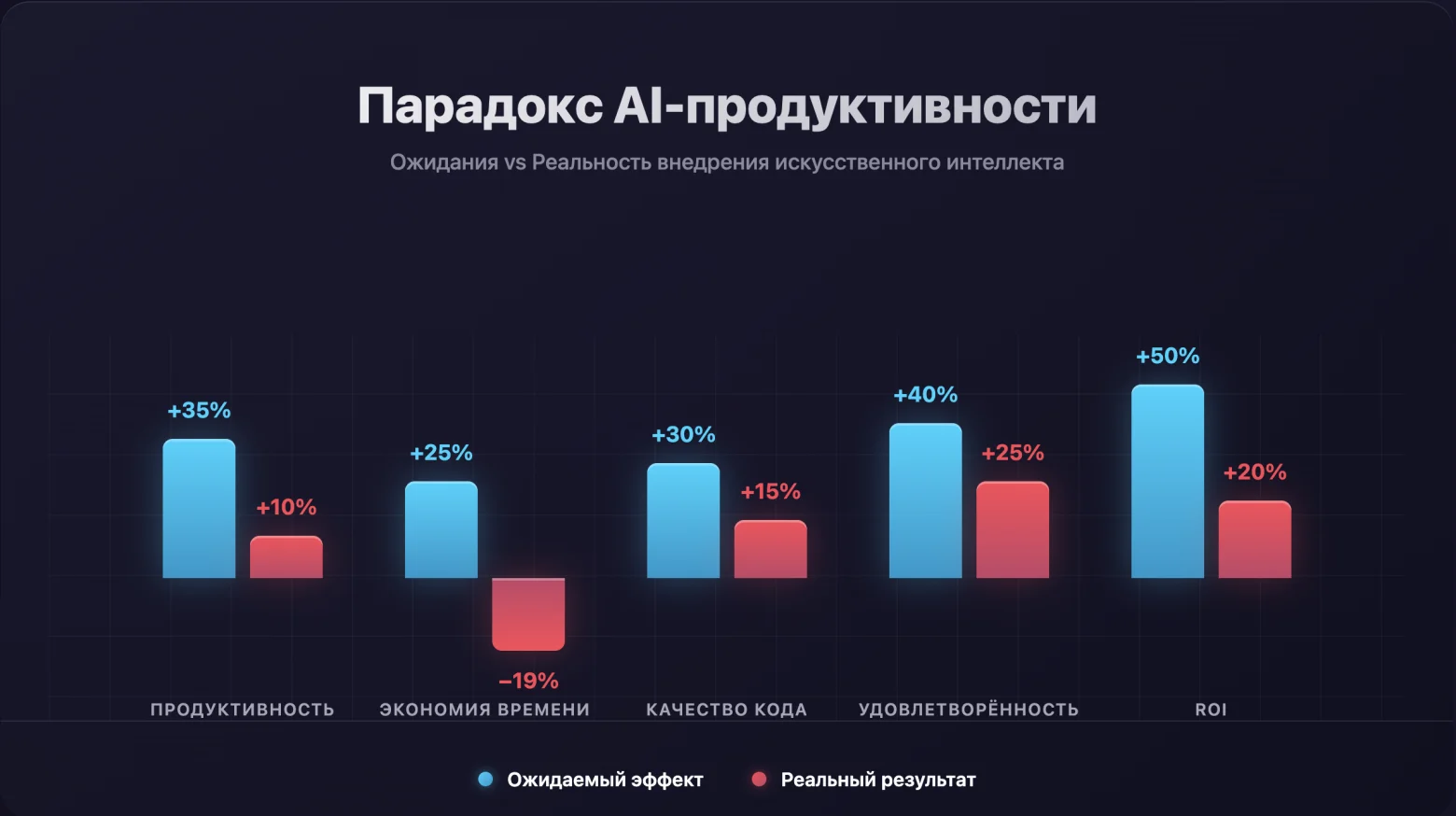
Engineering Leadership in the AI Era: Why 72% of Productivity Is Lost and How to Fight It
Three Myths That Kill AI ROI
Myth #1: "AI Automatically Boosts Productivity"
45% of AI implementation failures stem from naive belief in automatic productivity gains.
Context-switching overhead consumes up to 15% of time. Developers switch between their thinking and reviewing AI suggestions, losing flow state every 3-5 minutes.
Verification burden adds another 20-30% to task completion time. AI generates code that looks correct but contains subtle errors.
task_with_ai:
initial_generation: 2 min
context_explanation: 5 min
verification: 15 min
debugging: 20 min
integration: 10 min
total: 52 min
task_without_ai:
thinking: 10 min
implementation: 25 min
self_review: 5 min
total: 40 min
Myth #2: "Metrics Will Show the Real Picture"
Goodhart's Law: "When a measure becomes a target, it ceases to be a good measure."
Typical scenario: team gets KPI "30% of code must be written with AI." What happens next:
- Developers start using AI for trivial tasks (getters/setters, boilerplate)
- Complex algorithms and business logic are written manually
- Reports show "35% AI-generated code" ✅
- Real productivity drops by 10-15% ❌
def measure_ai_usage():
"""What we measure"""
return {
'lines_generated_by_ai': 10000,
'percentage_ai_code': 35,
'ai_tool_activations': 500
}
def measure_real_impact():
"""What actually happens"""
return {
'features_delivered': -15,
'bug_rate': +25,
'code_review_time': +40,
'developer_satisfaction': -20
}
Tool-over-process anti-pattern is the main cause of 80% AI project failures.
Companies spend millions on GitHub Copilot, Claude for Business, ChatGPT Enterprise licenses, but ignore processes.
Classic failure scenario:
- Week 1: "Everyone got Copilot! Productivity will skyrocket!"
- Week 4: "Why do we have so many bugs in production?"
- Week 8: "Code review now takes twice as long..."
- Week 12: "Disabling AI, returning to old processes"
The Productivity Paradox: Where Does 72% of the Gain Go
Research shows: 72% of time saved thanks to AI doesn't convert into additional output.
Parkinson's Law for AI
"Work expands to fill the time allotted for its completion."
before_ai:
task_estimation: 4 hours
actual_time: 3.5 hours
buffer_used_for: coffee_break
with_ai:
task_estimation: 4 hours
ai_saves: 1.5 hours
actual_time: 4 hours
extra_time_goes_to:
- perfect_is_enemy_of_good: 40%
- scope_creep: 30%
- over_engineering: 20%
- actual_productivity: 10%
The Expert Developer Paradox
AI slows down experienced developers on complex projects. The reasons are fundamental:
High code standards. Senior developers know 10 ways to solve a task and choose the optimal one. AI suggests the first working one. Time to redo > time to write from scratch.
Domain expertise. In a legacy system with 10 years of history, seniors know all the pitfalls. AI doesn't.
Complex integrations. Microservice architecture with 50 services requires understanding the entire system. AI sees only local context.
What You Should Actually Measure
Multidimensional Metrics Instead of "Lines of Code"
process_metrics:
lead_time:
from: "task created"
to: "deployed to production"
target: "< 2 days for small tasks"
cycle_time:
from: "work started"
to: "PR merged"
target: "< 8 hours"
review_turnaround:
measurement: "time to first review"
target: "< 2 hours"
ai_impact: "should decrease by 30%"
quality_metrics:
defect_escape_rate:
formula: "bugs_in_production / total_features"
baseline: "measure before AI"
target: "no increase with AI"
code_review_rejection_rate:
for_ai_code: "track separately"
for_human_code: "track separately"
compare: "should be similar"
technical_debt_accumulation:
measurement: "SonarQube debt ratio"
acceptable_increase: "< 5% per quarter"
business_metrics:
feature_delivery_rate:
measurement: "features/story_points per developer per sprint"
note: "quality > quantity"
developer_retention:
measurement: "turnover rate"
correlation: "with AI satisfaction"
innovation_index:
measurement: "% time on new initiatives"
target: "increase with AI automation"
Metrics Everyone Ignores (But Shouldn't)
Cognitive Load Index. How much mental energy does a developer spend on a task? AI should reduce it, but often increases it.
Knowledge Distribution Degree. How is system knowledge distributed in the team? AI can create dangerous dependency.
Bus Factor with AI Consideration. What happens if the AI tool becomes unavailable?
Five Implementation Strategies That Actually Work
Strategy 1: "Gradual Rollout with Measurement"
Start with one team, one process, one tool.
def gradual_ai_adoption():
baseline = measure_current_metrics()
pilot_team = select_early_adopters()
pilot_results = run_controlled_experiment(pilot_team)
if pilot_results.productivity_gain > 10:
scale_to_next_team()
elif pilot_results.productivity_gain > 0:
iterate_on_process()
else:
stop_and_rethink()
return gradual_rollout(lessons_learned)
Strategy 2: "Process-First Implementation"
Optimize the process first, then add AI.
Wrong: "Let's automate code review with AI"
Right: "Let's standardize code review first, then automate"
process_optimization_sequence:
week_1_2:
- define_code_review_checklist
- establish_review_sla
- create_review_templates
week_3_4:
- measure_baseline_metrics
- identify_bottlenecks
- document_common_issues
week_5_6:
- introduce_ai_for_simple_checks
- keep_human_review_for_logic
- measure_impact
week_7_8:
- analyze_results
- adjust_process
- scale_if_successful
Strategy 3: "AI as Safety Net"
Always have a fallback option. AI is enhancement, not replacement.
class DefensiveAIStrategy:
def code_review_with_ai(self, pull_request):
ai_review = self.ai_tool.review(pull_request)
if pull_request.touches_critical_path():
return RequireHumanReview(ai_review)
if pull_request.complexity < SIMPLE_THRESHOLD:
if ai_review.confidence > 0.95:
return AutoApprove(ai_review)
return RequireHumanReview(ai_review)
def fallback_when_ai_fails(self):
return self.traditional_process.execute()
Strategy 4: "Skill-Based Adoption"
Different approach for different developer levels.
adoption_by_seniority:
  junior_developers:
    ai_usage: "learning assistant"
    benefits:
      - faster onboarding
      - code examples
      - practical guidance
    risks:
      - over-reliance
      - superficial understanding
      - debugging skills atrophy
    mitigation:
      - mandatory code explanation
      - AI-free days
      - pair programming

  middle_developers:
    ai_usage: "productivity booster"
    benefits:
      - boilerplate automation
      - test generation
      - documentation generation
    risks:
      - quality vs quantity trap
      - reduced innovation
    mitigation:
      - dedicated innovation time
      - focus on quality metrics

  senior_developers:
    ai_usage: "exploration tool"
    benefits:
      - rapid prototyping
      - exploring new technologies
      - architecture validation
    risks:
      - verification overhead
      - quality disappointment
    mitigation:
      - selective task usage
      - building custom tools
Strategy 5: "Cultural Integration"
AI is a culture change, not just a new tool.
## AI Culture Manifesto

### Our Principles:
1. AI amplifies our capabilities
2. Quality over quantity
3. Understanding first, automation second
4. If you don't measure it, you can't manage it
5. Fast experiments and learning

### Our Practices:
- AI-free Fridays to preserve skills
- Team review of AI-generated code
- Innovation Time (20% for AI experiments)
- Failure Post-Mortems (blameless retrospectives)
Anti-patterns: How NOT to Implement AI
Anti-pattern #1: "Big Bang Adoption"
❌ Wrong: "Starting Monday, everyone switches to AI tools!"
Consequences:
- Process chaos
- Sharp productivity drop
- Team resistance
- Rollback impossible
✅ Right: Gradual rollout with measurements and checkpoints.
Anti-pattern #2: "Metrics Theater"
❌ Wrong: Beautiful dashboards with meaningless metrics.
useless_metrics:
- ai_tool_logins_per_day
- lines_of_ai_generated_code
- percentage_of_ai_usage
- ai_suggestions_accepted
meaningful_metrics:
- time_to_production
- defect_escape_rate
- developer_satisfaction
- feature_completion_rate
Anti-pattern #3: "AI for Everything"
❌ Wrong: "We have problem X? Let's solve it with AI!"
Real case: Team spent lots of time on code review. Bought AI tool for $50k/year. Result? Code review took EVEN longer.
✅ Right: Root cause analysis first, then solution selection.
Anti-pattern #4: "Ignoring Skeptics"
❌ Wrong: "Old developers just don't understand progress!"
Senior developers often spot real issues first:
- Hidden bugs in AI-generated code
- Architectural mismatches
- Security vulnerabilities
- Performance problems
✅ Right: Engage skeptics as "devil's advocates."
Real Cases: What Works and What Doesn't
Case 1: Unit Test Automation ✅
What worked:
- Focus on simple, repetitive tests
- Humans write edge cases
- AI generates boilerplate and simple cases
- Result: 40% time savings on testing
Case 2: AI Code Review ❌→✅
What DIDN'T work initially:
- AI reviewed everything
- Tons of false positives
- Developers ignored comments
What was fixed:
- AI does only basic checks and finds vulnerabilities
- Humans handle logic and architecture
- Result: 25% faster reviews without quality loss
Case 3: Documentation Generation ✅
Why it worked:
- Documentation is ideal task for AI
- Easy to verify results
- Not critical for production
- Result: 60% time savings
documentation_strategy:
  ai_generates:
    - api_documentation
    - code_comments
    - readme_templates
    - changelog_entries

  human_writes:
    - architecture_decisions
    - business_logic_explanation
    - troubleshooting_guides
    - post_mortems
ROI: Calculating Real Value
def calculate_real_ai_roi(team_size, ai_cost_per_month):
"""
Real ROI calculator accounting for hidden costs
"""
direct_costs = {
'licenses': ai_cost_per_month,
'training': team_size * 2000,
'infrastructure': 5000
}
hidden_costs = {
'productivity_dip': team_size * 10000,
'process_redesign': 20000,
'quality_issues': 15000,
'tool_integration': 10000
}
real_benefits = {
'simple_task_automation': team_size * 5000,
'documentation_improvement': 8000,
'onboarding_acceleration': 6000,
'reduced_context_switching': team_size * 3000
}
potential_benefits = {
'innovation_time': team_size * 8000,
'improved_quality': 15000,
'faster_delivery': 20000
}
first_year_roi = (
sum(real_benefits.values()) * 0.7 +
sum(potential_benefits.values()) * 0.3
) - (
sum(direct_costs.values()) * 12 +
sum(hidden_costs.values())
)
return {
'first_year_roi': first_year_roi,
'breakeven_months': calculate_breakeven(),
'recommendation': 'GO' if first_year_roi > 0 else 'WAIT'
}
Manager's Checklist
Before AI Implementation:
- Measured baseline metrics (minimum 1 month of data)
- Defined specific problems to solve
- Selected pilot team (no more than 20%)
- Prepared rollback plan
- Trained team (not just tools, but processes)
- Set up ROI measurement
- Prepared for productivity dip (first 2 months)
During Implementation:
- Weekly retrospectives
- Real-time metrics tracking
- Quick process adjustments
- Documenting lessons learned
- Engaging skeptics
- Celebrating small wins
After 3 Months:
- Full ROI analysis
- Scaling decision
- Strategy adjustment
- Knowledge sharing with other teams
- Process and documentation updates
Key Takeaways
AI in development is not about tools, it's about culture and process change. Successful implementation requires:
-
Acknowledging paradoxes. AI can slow down best developers and speed up juniors. That's normal.
-
Process focus. Optimize the process first, then automate. Not the other way around.
-
Right metrics. Forget about lines of code. Measure lead time, quality, and satisfaction.
-
Gradual approach. Big Bang adoption = guaranteed failure. Start small, measure, scale.
-
Cultural adaptation. AI is a new team member. Treat it accordingly.
Most important: The "lost" 72% of AI productivity improvement isn't lost at all. It goes to quality improvement, innovation, learning, and work-life balance. That's not a bug — it's a feature. The right question isn't "How to get 100% productivity boost?" but "How to use freed-up time most effectively?"
P.S. If your team shows 200% productivity boost from AI — congratulations, you're successfully gaming metrics. Real sustainable gain is 15-25% after 6 months of adaptation. And that's an excellent result.
Need Help Implementing AI in Your Team?
At WebProd, we help companies implement AI automation pragmatically — with realistic expectations and measurable results.
What we offer:
- AI automation strategy consulting
- Custom AI assistants and integrations
- RAG systems for internal knowledge bases
- Team training and adoption guidance
AI Automation Services →
AI solutions from $60. Realistic ROI expectations.
Related services: